
Sharps Handling
What You Need to Do
If you work with needles, syringes, scalpels, razor blades, broken glass, pipettes, pipette tips, or other items that can puncture skin or a waste container:
- Avoid sharps when a safer alternative will work. Use needle-free methods, blunt needles, safety-engineered devices, or plasticware where practical.
- Plan how you will control and dispose of the sharp before you start. Keep the appropriate puncture-resistant disposal container or other approved containment at the point of use.
- Keep control of exposed sharps. Do not pass exposed sharps directly from one person to another. Use a neutral zone or rigid tray when procedures involve multiple people.
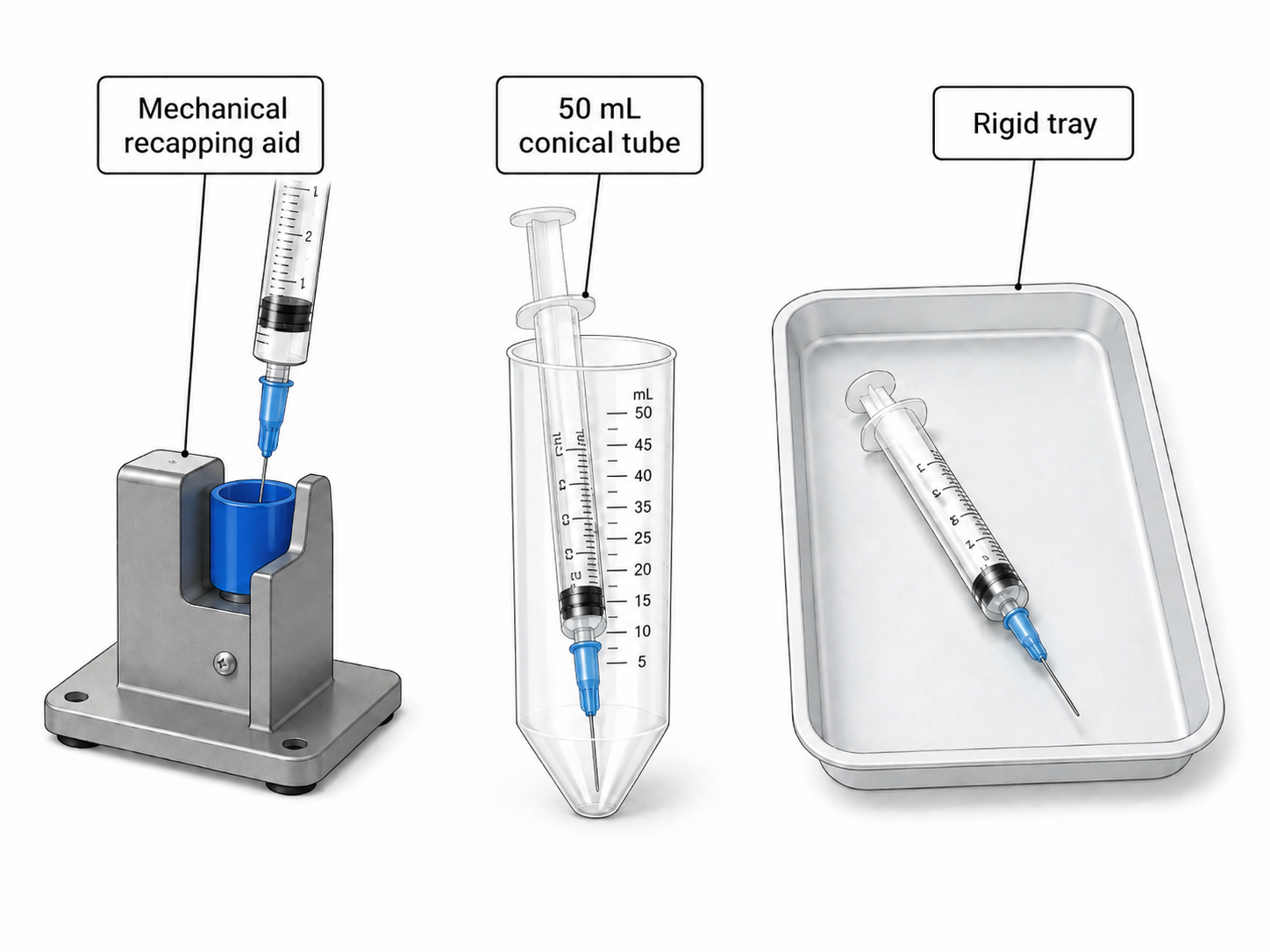
- Do not bend, break, shear, or routinely recap contaminated needles. If recapping is required by the procedure or no feasible alternative exists, use a one-handed technique or mechanical recapping aid.
- Use the correct waste container. A sharp does not automatically belong in a red sharps container. Determine the biological, chemical, radiological, or other hazard first, then use the corresponding disposal pathway.
- If you are injured, act immediately. Perform first aid, obtain prompt medical evaluation, notify your supervisor, and report the incident. See If You Are Injured.
- If your laboratory purchases or possesses hypodermic needles or syringes, determine whether a New York State Certificate of Need is required. See Certificate of Need.
What Is a Sharp?
A sharp is an item capable of causing a percutaneous injury or puncturing a waste container. In research laboratories, sharps include hypodermic needles, syringes with attached needles, scalpel blades, razor blades, Pasteur pipettes, broken glass, glass slides and coverslips, serological pipettes, micropipette tips, and similar rigid items capable of causing a puncture.
New York State regulated medical waste requirements use a broad definition of sharps that includes needles and other items capable of causing puncture injury, including Pasteur pipettes and certain glass and plastic items. Cornell also requires puncture-resistant containment for laboratory sharps that are not regulated medical waste in order to protect laboratory, custodial, and waste-handling personnel.
Not every sharp belongs in a red sharps container. The appropriate containment and disposal pathway depend on the item and what it contacted. Serological pipettes, micropipette tips, and similar puncture hazards must be managed so they cannot puncture an outer waste bag or expose waste-handling personnel.
Before You Start
- Eliminate the sharp if possible. Use needle-free methods, plasticware, blunt devices, or other alternatives where they will accomplish the task.
- Select a safer device. Use safety-engineered sharps when required or appropriate to the risk.
- Consider the exposure consequence. Evaluate the biological, chemical, radiological, or other material involved and the consequence if it were introduced through a puncture.
- Plan the workflow. Decide where the sharp will be used, how it will be controlled between procedural steps if necessary, and how it will be discarded.
- Place the disposal container at the point of use. The appropriate container should be visible and within easy reach before the procedure begins.
- Make sure personnel are trained and proficient. Procedure-specific training or demonstrated proficiency may be necessary for higher-risk sharps procedures.
Where the OSHA Bloodborne Pathogens Standard applies, laboratories must evaluate and use appropriate engineering and work-practice controls, including appropriate commercially available safer sharps devices.
During Use
- Handle one exposed sharp at a time whenever practical. Keep the sharp visible and under your control throughout the procedure.
- Do not hand exposed sharps directly from one person to another. For procedures involving multiple people, establish a neutral zone or rigid tray where the sharp can be placed and retrieved.
- Use Luer-lock syringes when a secure syringe-needle connection is needed. A Luer-lock connection helps prevent accidental separation but is not itself a safety-engineered sharps device.
- Avoid carrying an exposed sharp across the laboratory. If movement is required by the procedure, maintain control of the sharp and minimize the distance traveled.
- Use a controlled temporary holder when repeated use is necessary. If the same syringe and needle will be used for multiple injections or procedural steps, keep it in a stable location between uses. A clean, open 50 mL conical tube, rigid tray, or other purpose-appropriate holder can prevent rolling and inadvertent contact. Dispose of the sharp promptly when the procedure is complete.
- Use secondary containment when transporting filled sharps containers. Secure the closed container against tipping or release during transport.
- Replace sharps containers before they overfill. Replace them at approximately three-quarters full or sooner if the manufacturer's fill line is reached.
Unsafe Sharps Practices
- Do not routinely recap needles. Eliminate recapping unless it is required by the procedure or no feasible alternative exists.
- Do not recap using two hands. Never hold a needle cap with one hand while directing an exposed needle toward it with the other.
- Do not bend, break, shear, or manually remove contaminated needles as a means of disposal.
- Do not leave exposed sharps loose on a bench. If temporary placement is necessary during a procedure, use a controlled holder or neutral zone.
- Do not use your hands to collect broken glass or loose sharps. Use forceps, tongs, a broom and dustpan, or another mechanical means.
- Do not place loose sharps in plastic bags, red bags, or other soft-sided waste containers. Serological pipettes, micropipette tips, and other puncture hazards must be contained or otherwise secured so they cannot puncture the outer bag.
- Do not choose a waste container based only on the fact that an item is sharp. Identify the hazard and contamination first, then select the correct container and waste pathway.
Recapping: Avoid It Unless the Procedure Requires It
Do not routinely recap used needles. If a procedure requires repeated use of the same needle, or recapping is otherwise necessary and no feasible alternative exists, use a mechanical recapping aid or a one-handed scoop technique. Never hold the cap with the other hand.
One-Hand Scoop Method
- Place the cap on a stable surface. Do not hold the cap with your other hand.
- Using the hand holding the syringe, guide the needle into the cap with a scooping motion.
- Once the cap is engaged, secure it using a one-handed technique or mechanical device without placing the other hand near the exposed needle.
Dispose of Sharps Correctly
What the item is and what contaminated it determine the waste stream. All sharps must be placed in rigid, puncture-resistant, leak-proof containment before disposal unless an approved waste procedure provides another method that prevents puncture. The fact that an item is sharp does not automatically make it regulated medical waste.
Choose the Container by Hazard
Do not use a red sharps container for chemical-only or other non-RMW sharps. A red sharps container places the contents into Cornell's regulated medical waste or biohazardous waste pathway. Use red only when the waste belongs in that pathway.
- Red sharps container: Use for regulated medical waste sharps and other biohazardous sharps specifically directed to the RMW pathway.
- Yellow sharps container: Use for designated chemotherapeutic, hazardous-drug, toxin, or other waste specifically assigned to a yellow-container pathway by the applicable Cornell procedure.
- Chemical-only sharps: Use a rigid, puncture-resistant, leak-proof container compatible with the chemical. Do not use a red sharps container. Manage the container through the chemical hazardous-waste pathway when applicable.
- Radioactive sharps: Follow Radiation Safety requirements. If a radioactive sharp is also RMW, manage both hazards as directed by Radiation Safety and the applicable waste procedure.
- Nonhazardous laboratory sharps: Use rigid, puncture-resistant containment appropriate to the item and disposal pathway. Do not use a red sharps container merely because the item is capable of puncture.
| Item or contamination | Container | What to do |
|---|---|---|
| Regulated medical waste or biohazardous sharps | Red sharps container | Manage through Cornell's regulated medical waste program. |
| Serological pipettes, micropipette tips, slides, razor blades, syringes without needles, and similar puncture hazards contaminated with biological material | Rigid, puncture-resistant, leak-proof containment appropriate to the biological waste pathway | Follow the EHS Lab Waste Guide. Use a red sharps container when the material is being managed as RMW. Where an approved treatment pathway allows subsequent regular-trash disposal, use the puncture-resistant containment specified for that pathway. |
| Chemical-only sharps or puncture hazards | Rigid, puncture-resistant, leak-proof, chemically compatible container. Do not use a red sharps container. | Manage through the applicable chemical waste pathway. If the contents are hazardous waste, label and manage the container as hazardous waste. Do not apply or retain a biohazard designation unless a biological hazard is actually present. |
| Chemotherapeutic, hazardous-drug, toxin, or other material assigned by Cornell procedure to a yellow sharps pathway | Yellow sharps container | Follow the applicable hazardous-drug, toxin, or other specific waste procedure. Do not use yellow solely because the waste is chemical. |
| Radioactive contamination | Appropriate radioactive sharps container | Follow Radiation Safety requirements. Segregate radioactive sharps from non-radioactive waste unless an approved mixed-waste pathway applies. |
| Uncontaminated serological pipettes, micropipette tips, broken glass, glass Pasteur pipettes, slides, coverslips, or similar laboratory puncture hazards | Rigid, puncture-resistant containment appropriate to the item and disposal pathway | Manage through the applicable laboratory glass or regular-waste pathway. Do not place loose items into trash bags. Do not use a red sharps container unless the waste is actually being managed as RMW. |
| More than one hazard | Depends on the combination of hazards | Contact EHS before generating mixed-hazard sharps waste when feasible, or promptly after an unplanned generation event. |
See the Lab Waste Guide for detailed waste-stream requirements.
If You Are Injured
Act immediately after a needlestick, cut, or other sharps exposure.
- Perform first aid.
- Needlestick or cut: Wash the area thoroughly with soap and water.
- Exposure to the eyes, nose, or mouth: Flush with water or saline.
- Obtain prompt medical evaluation appropriate to the exposure. Tell the medical provider that the injury occurred at work or during research and identify the biological, chemical, radiological, or other material involved.
- Notify your supervisor.
- Report the injury or exposure through the Cornell University Injury/Illness/Exposure Reporting system.
- Preserve information about the source material. Retain the identity, concentration, and other relevant information about the materials involved. Do not transport the contaminated sharp to the medical provider.
For a medical emergency, call 911.
Report Near Misses and Unsafe Conditions
Sharps near misses and unsafe conditions can identify equipment, procedure, workspace, or training problems before an injury occurs. Report concerns through the EHS Incident Reporting Portal or contact EHS.
New York State Certificate of Need for Hypodermic Needles and Syringes
Important: The Certificate of Need requirements in this section apply specifically to regulated hypodermic syringes and needles. They do not apply to every item considered a sharp for injury-prevention or waste-management purposes.
Do I Need a Certificate of Need?
New York State regulates the purchase and possession of hypodermic needles and syringes. Certain licensed professionals and other specified activities are exempt from the Certificate of Need requirement when acting within the scope of those professional activities.
If an exemption does not apply, the laboratory must obtain a Certificate of Need before purchasing or receiving hypodermic needles or syringes. If you are unsure whether an exemption applies to your work, contact EHS before procurement.
Responsibilities and Records
At Cornell, the PI or laboratory director responsible for the needles and syringes completes the Certificate of Need application and submits it directly to the New York State Department of Health Bureau of Narcotic Enforcement (BNE).
- Obtain the Certificate of Need before procurement. Use Cornell's Counsel-approved Certificate of Need to Possess Hypodermic Syringes and Needles application package. The package contains the NYSDOH DOH-2278 application and Cornell institutional documentation. Complete the required sections and submit the application directly to BNE using the instructions provided in the form.
- Identify the person responsible for supervising use. This individual is responsible for overseeing the use of hypodermic syringes and needles and maintaining applicable records for items under their supervision.
- Identify the person or people responsible for custody. These individuals are responsible for safeguarding hypodermic syringes and needles and maintaining applicable records of receipt and disposition.
- Identify the authorized locations of use. The Certificate of Need may identify classrooms, laboratories, lecture halls, departments, divisions, or other authorized locations.
- Maintain a running inventory. Record the type, size, quantity received, quantity distributed, balance on hand, and applicable dates. Use the Cornell Syringe and Needle Log.
- Complete a physical inventory each June 30. Reconcile and document the physical inventory in the laboratory's records.
- Document destruction, loss, and theft as applicable. Maintain the information required by the Certificate of Need recordkeeping requirements.
- Maintain required records for at least two years.
- Report any loss or theft immediately to NYSDOH BNE. Notify EHS at the same time.
- Report changes in designated custodial or supervisory personnel to NYSDOH within 30 days.
- Report changes in the authorized location of use to NYSDOH within 30 days.
- Maintain records and stocks so they are available for inspection. Required records and stocks of hypodermic syringes and needles must be readily available to authorized representatives of the New York State Commissioner of Health.
Storage Requirements
Hypodermic needles and syringes must be secured against unauthorized access when they are not in use.
- Cornell uses keyed locking storage to meet the New York State security requirement.
- Spring locks and combination dial locks are not acceptable.
- Reserve or main stock must be kept within two stationary locked cabinets.
- Needles and syringes that are not part of reserve or main stock and are not actively in use must remain under suitable locked protection.
Disposal of Hypodermic Needles and Syringes
Unusable or unneeded hypodermic needles and syringes must be rendered inoperable through the approved disposal process. Do not bend, break, shear, or manually destroy used needles. Place the syringe and needle into the appropriate rigid sharps container and manage the container through the applicable Cornell waste stream described above.
Forms and Resources
- Certificate of Need to Possess Hypodermic Syringes and Needles — Cornell Counsel-approved application package for submission to the NYSDOH Bureau of Narcotic Enforcement
- Syringe and Needle Log — Cornell form for maintaining the inventory required by New York State
- Lab Waste Guide — laboratory waste-stream guidance, including disposal requirements for pipette tips, serological pipettes, glass, biological sharps, chemical sharps, and mixed waste
- Regulated Medical Waste — Cornell RMW program
- Injury/Illness/Exposure and Incident Reporting
- Bloodborne Pathogens
- EHS: (607) 255-8200 or AskEHS@cornell.edu
- Emergency: 911
Primary requirements and guidance include 10 NYCRR Part 70, 10 NYCRR §80.133, 29 CFR 1910.1030, applicable New York State waste requirements, Cornell University Policy 8.6, and applicable Cornell EHS written programs. Last reviewed: August 2026.
More Information
- Follow the EHS Lab Waste Guide to determine the correct disposal pathway based on the materials your sharps have contacted. All sharps must be placed in appropriate rigid, puncture-resistant containment before disposal.
- Visit the EHS Bloodborne Pathogens page if your work may involve occupational exposure to human blood or other potentially infectious materials (OPIM). Research involving human or non-human primate-derived materials must also be addressed through the applicable laboratory exposure determination and IBC Memorandum of Understanding and Agreement (MUA).
- Complete required Bloodborne Pathogens training before beginning work with occupational exposure to blood or OPIM. Current training offerings are available through Workday Learning; contact EHS if the required course is not listed.
- If your laboratory purchases or possesses hypodermic syringes or needles and a New York State exemption does not apply, use the Cornell Counsel-approved Certificate of Need application package. The PI or laboratory director completes the application and submits it directly to the New York State Department of Health Bureau of Narcotic Enforcement as described above.
- Use the Cornell Syringe and Needle Log to maintain the running inventory and document the required June 30 physical inventory for hypodermic syringes and needles subject to the Certificate of Need requirements.
- Report sharps injuries, exposures, near misses, and unsafe conditions through the Cornell University Injury/Illness/Exposure and Incident Reporting system.
Primary requirements and guidance: 29 CFR 1910.1030 (OSHA Bloodborne Pathogens); 10 NYCRR §§80.132–80.133 (NYS DOH hypodermic syringe and needle exemptions and Certificate of Need requirements); 10 NYCRR Part 70 and applicable 6 NYCRR Parts 360–365 requirements for regulated medical waste; 40 CFR Part 261 where sharps are hazardous chemical waste; applicable radiation safety requirements; Cornell University Policy 8.6; and applicable Cornell EHS written programs. Last reviewed: August 2026.